Two works by Thomas Robins the Elder prompted collaborative treatments by painting and paper conservators at the Yale Center for British Art.


Thomas Robins the Elder, View of Gloucestershire Country House (left) and View of a Gloucestershire Country House: A Garden View, with Picnic Party in Center Foreground (right), ca. 1755
In fall 2023, conservators at the Yale Center for British Art (YCBA) finished restoring two paintings by Thomas Robins the Elder, both purchased by museum founder Paul Mellon (Yale College Class of 1929). The works were made around 1755 and depict different views of a Gloucestershire country house.
A talented botanical artist and fan painter, Robins often portrayed English country houses and gardens. He painted these two works using pigments ground in animal glue on stretched vellum over a wooden strainer. Very loosely woven gauzelike pieces of fabric separated the vellum and the strainer, creating more complicated supports than those found in traditional oil-on-canvas paintings. These objects needed care from both paper and painting conservators at the Yale Center for British Art: the painting conservators removed the varnish, while the paper conservators addressed the issues in the vellum support.
The vellum—stiff and desiccated to the touch—was scalloping and curling up around the nailed edges. Originally, the artist would have moistened the vellum to make it malleable, affixing it to the wooden strainer with tacking nails along the sides before it dried completely. When dried, the vellum support was meant to be taut and drum-like, ideal for painting. However, the structural integrity of the paintings was compromised when some of the tacks corroded and ate through the vellum. The vellum became slack, shrank, and developed localized distortions. The thick varnish on both works had yellowed significantly shifting the colors of the paintings. The goal of the treatment was to address the distorted vellum, restore tension where shrinkage had occurred, stabilize weakened areas to prevent further damage, and remove and replace the aged varnish.
Before treatment began, the YCBA’s imaging team documented the works with a complete suite of photos, including the backs, fronts, and details of each piece. Infrared photography and x-radiography helped the conservators assess the painting structure and technique.
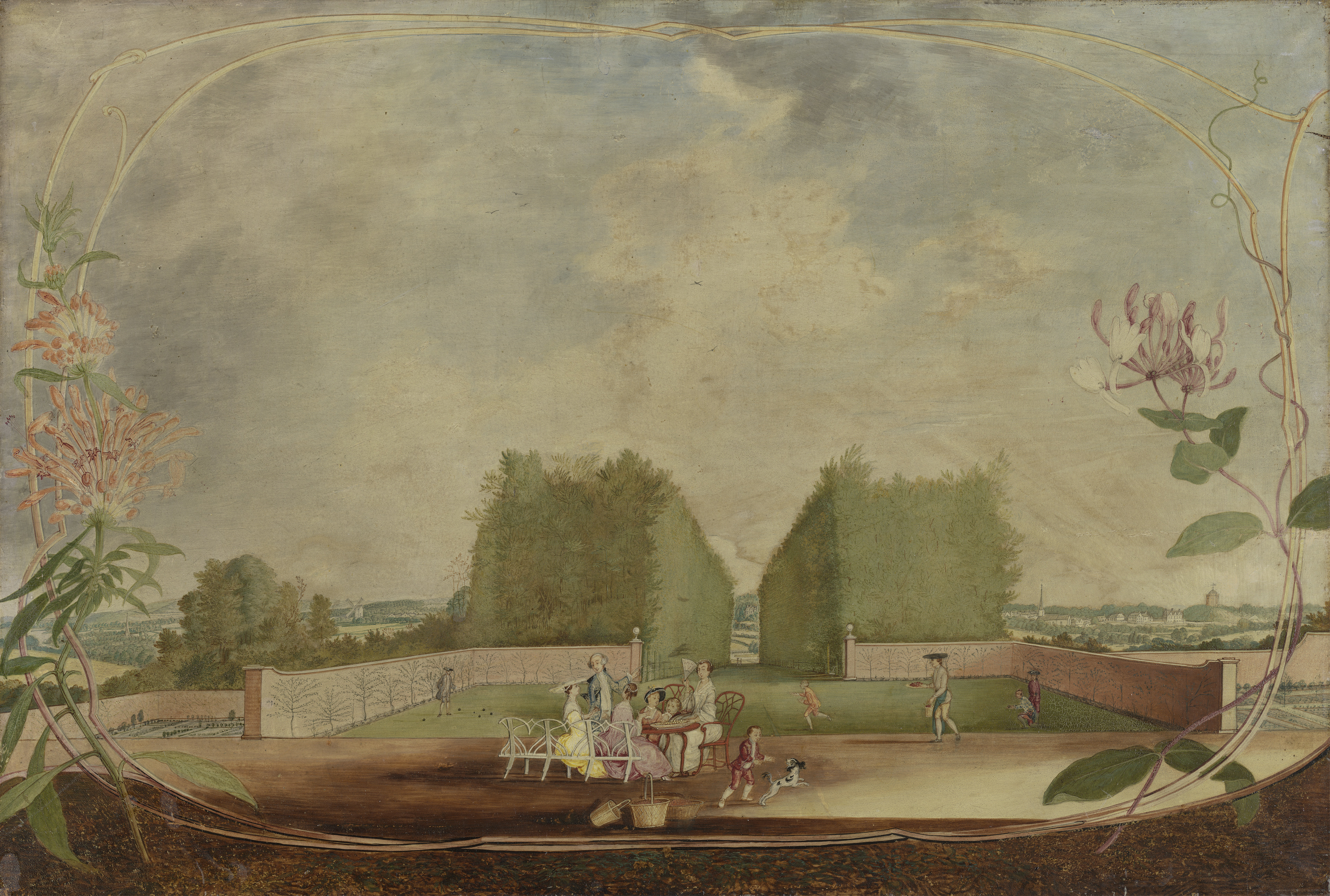
Before treatment, View of a Gloucestershire Country House: A Garden View, with Picnic Party in Center Foreground

Ultraviolet imaging, View of a Gloucestershire Country House: A Garden View, with Picnic Party in Center Foreground
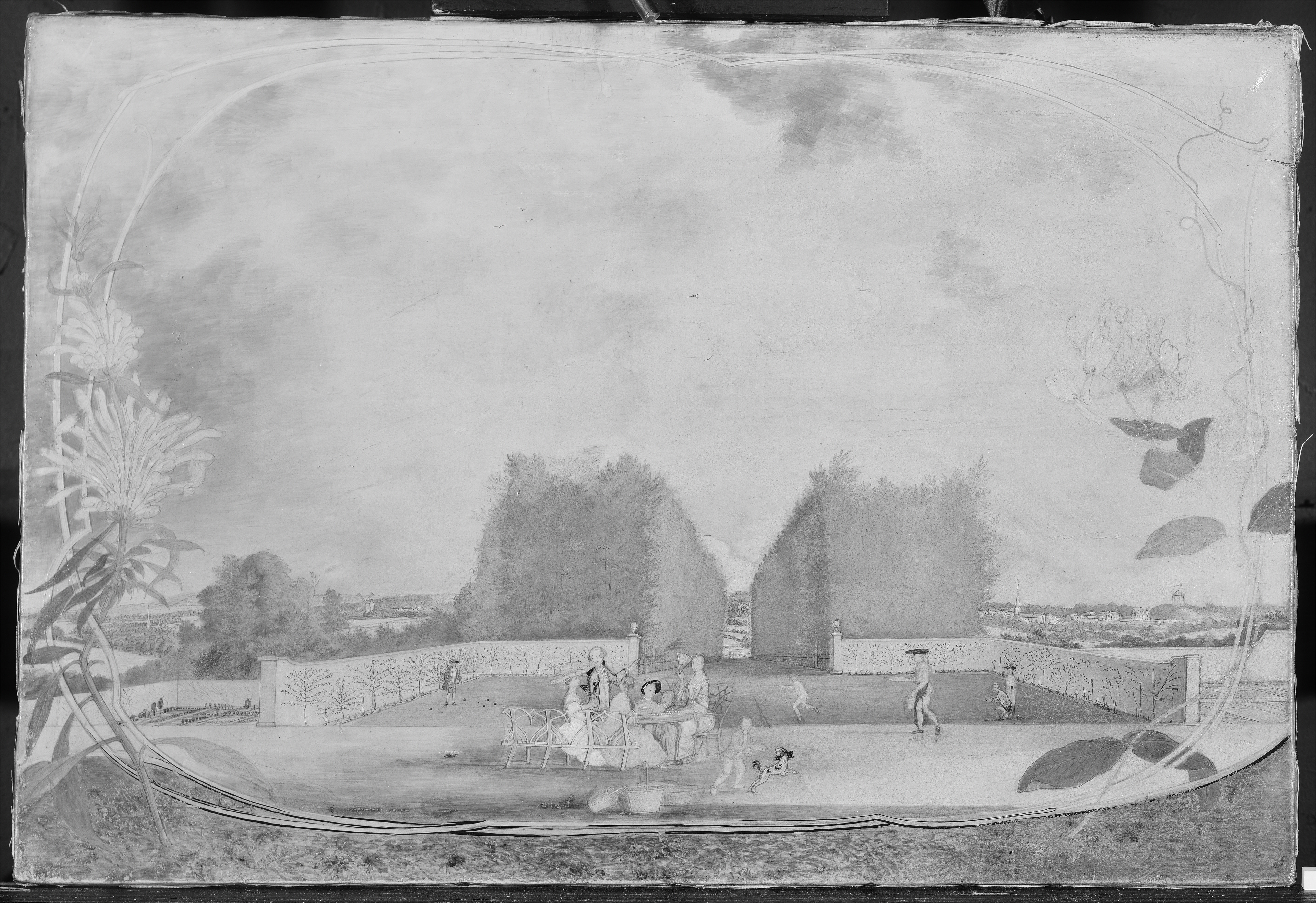
Infrared Reflectography, View of a Gloucestershire Country House: A Garden View, with Picnic Party in Center Foreground
View of a Gloucestershire Country House: A Garden View, with Picnic Party in Center Foreground was treated first, beginning in early 2019. Paintings conservator Mark Aronson, Deputy Director and Chief Conservator, examined the structure of the paintings using X-ray images and temporarily removed selected rusty nails to facilitate localized treatment of the vellum. Next, Soyeon Choi, Head of Paper Conservation, applied laminated Korean mulberry paper strips with gelatin underneath the affected areas where the vellum required re-stretching. After a brief humidification process from beneath, the vellum was stretched by pulling down the paper strips and securing them under tension using bulldog clips and pins onto an elevated wooden support. The painting was counter-weighted to maintain the tension. Once the vellum had dried and stabilized, the ends of the paper strips were released from the clips and affixed to the verso of the strainer using gelatin.
Anita Dey, Assistant Paper Conservator, began treating the other work, View of Gloucestershire Country House, in the fall of 2021, which exhibited more significant distortions in the vellum support. The half-inch tacking nails in the lower left quadrant were removed where the distortion was most severe. The nails were kept to reposition them later. As with the work completed in 2019, paper strips were added to the back of the tacking edges of the affected areas. To address the distortion, Dey lightly humidified the lower left quadrant of the vellum using a blotter dampened with deionized water from underneath and stretched as described above except the hinges were secured under tension using linen tape onto a wooden support. This process was repeated multiple times to gradually reduce the planar distortions. The addition of several humidification packages dampened with either 80 % or 91% isopropanol to the humidification process proved an effective way of controlling the drying rate of the vellum for even shrinkage. When the vellum visibly regained the planarity, the object dried for several weeks under tension. Finally, Dey mended the weakened edges of the vellum, repaired the silk ribbons that wrapped around the strainer, and removed the varnish in this work.

Anita Dey addressing tears along the edge of View of Gloucestershire Country House, paper conservation studio, Yale Center for British Art, photo by YCBA staff
After treatment, both paintings were revarnished. Then student worker Dory Johnson (Yale University 2024) and Aronson worked in tandem to retouch the areas of loss on both paintings, assuring that the two paintings matched as a pair, as they were originally intended. The conserved works will be on view when the museum reopens in April 2025.

Dory Johnson, Jonathan Edwards ’24, retouching View of Gloucestershire Country House, painting conservation studio, Yale Center for British Art, photo by YCBA staff

